Matchbox Moving Parts: A Beginner’s Guide to Opening Features and Variations
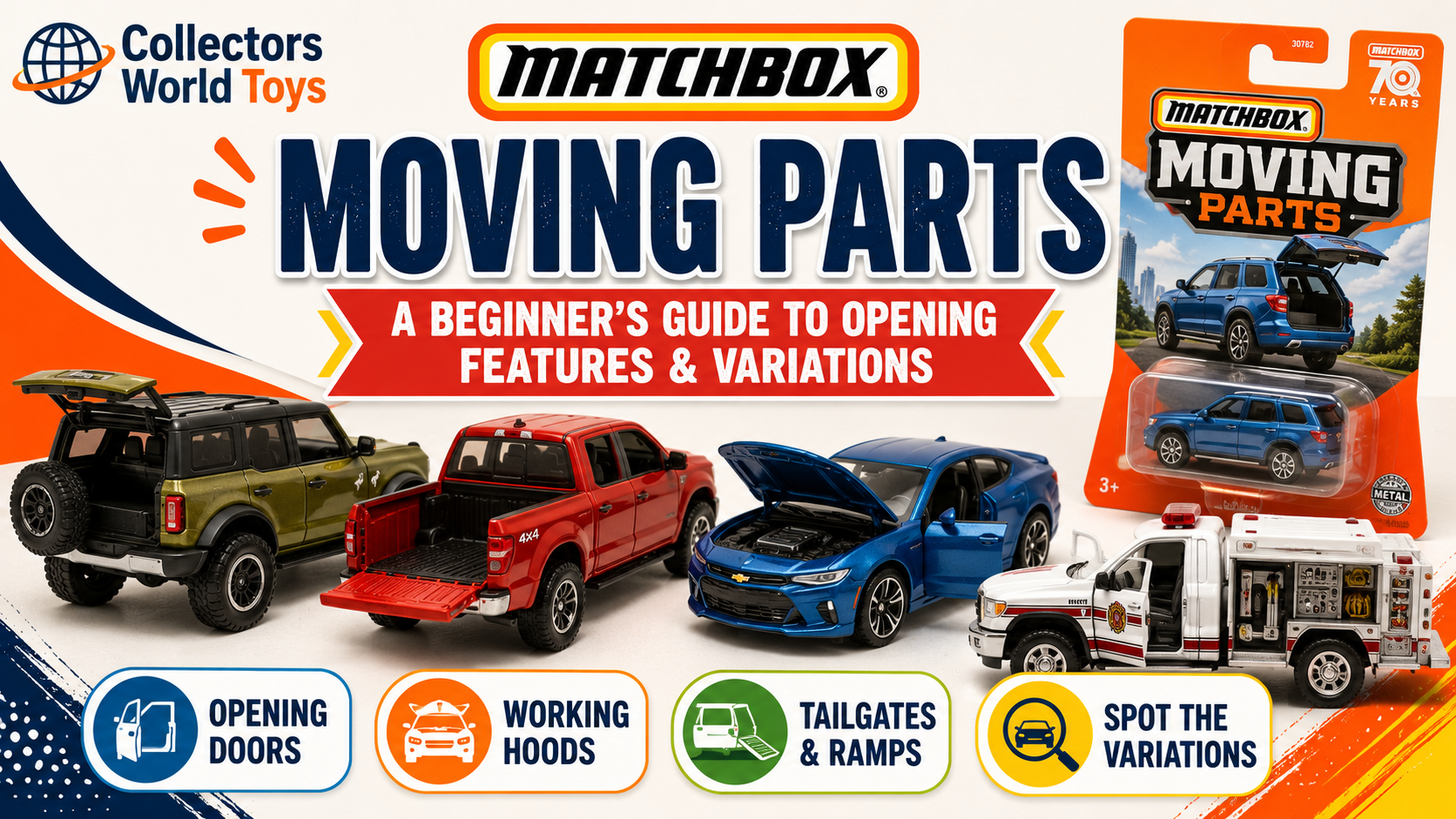
Matchbox Moving Parts vehicles add an interactive element to realistic diecast collecting. Instead of remaining completely fixed, each model includes at least one component designed to open, tilt, rotate, fold, slide, or move.
Depending on the casting, that feature may be a hood, door, tailgate, cargo ramp, dump bed, ladder, roof panel, or piece of construction equipment. Moving Parts models are a natural next step for collectors who enjoy standard Matchbox mainline vehicles but want additional detail and display possibilities.
What makes a Matchbox vehicle a Moving Parts release?
A Moving Parts vehicle is designed around a functional component. Common features include:
- Opening front or rear doors
- Opening hoods
- Opening trunks or liftgates
- Working tailgates
- Tilting dump beds
- Folding cargo ramps
- Rotating ladders
- Moving excavator buckets
- Adjustable construction equipment
Moving Parts releases are generally positioned between basic Matchbox mainline vehicles and higher-priced collector-focused products. The working component is the defining feature.
How to open the feature safely
Never force a moving part. Small hinges, tabs, and pivots can bend or break if pulled beyond their intended range.
Hold the vehicle by the solid body rather than mirrors, ladders, roof racks, or other thin accessories. Use a fingernail or a smooth plastic tool to begin opening a tight panel. Avoid metal screwdrivers because they can scratch paint.
Move the feature slowly the first time. Stop when resistance increases. Some doors and hoods are only designed to open partway.
A small amount of paint may bridge a panel seam during production. Gentle movement may release it, but a valuable vehicle is better left closed than damaged by aggressive prying.
Understanding panel gaps
Not every Moving Parts casting uses the same hinge design. Some parts rotate on visible metal pins, while others use molded plastic tabs or internal hinges.
A wider door gap is not automatically a defect. The casting may need additional clearance to prevent the moving panel from scraping the body.
Compare several examples before deciding that a hinge, panel position, or gap is unusual.
Variations collectors may encounter
Matchbox Moving Parts variations can include:
- Body color
- Wheel design
- Graphics
- Interior color
- Window tint
- Base color
- Moving-panel color
- Packaging differences
A later production batch may use another wheel type or slightly revised decoration. Multi-pack and regional releases may also differ from single-card versions.
One poorly aligned panel or missing paint application is more likely to be a factory error than an intentional variation.
What to inspect before buying
For carded models, inspect the blister and make sure the moving component has not shifted into an unnatural position. Look for paint rub where doors or hoods touch the body.
For loose vehicles, test the mechanism gently. The part should move without grinding or excessive looseness. Check that doors close evenly, the hood sits reasonably flush, and construction equipment remains attached.
Minor panel gaps are normal. Broken hinge tabs, missing parts, deep chips, and detached panels are more serious concerns.
Carded or loose?
Moving Parts vehicles are especially enjoyable loose because their features can be used and photographed. Keeping one sealed preserves the packaging and protects delicate components.
Collectors who enjoy both styles may purchase two examples of favorite castings: one carded and one to open.
Storage tips
Store loose Moving Parts vehicles in individual compartments. Leave room for mirrors, ladders, booms, and opening panels.
Close moving features during long-term storage unless the mechanism is specifically designed to remain open. Raised parts are easier to damage and may place stress on hinges.
Final thoughts
Matchbox Moving Parts combines realistic vehicles with simple mechanical features. Choose castings that interest you, operate them gently, and compare multiple examples before identifying a variation.
2. How to Read Hot Wheels Package Numbers, Series Numbers, and Case Codes
Meta description: Learn how to read Hot Wheels package numbers, mini-series fractions, collector numbers, toy numbers, date codes, and assortment case letters.
Tags: Hot Wheels Guides, Hot Wheels Package Numbers, Hot Wheels Case Codes, Beginner Guides, Hot Wheels Collecting, Mainline Hot Wheels, Collecting Tips
A Hot Wheels package can contain several numbers, letters, and codes. New collectors sometimes assume that every number indicates rarity, but most are used for organization, manufacturing, or retail distribution.
Understanding the package helps identify the exact release and makes it easier to organize a collection.
The mini-series fraction
A fraction such as 3/10 identifies the car’s position within a themed mini collection.
A vehicle marked 3/10 is the third entry in a ten-vehicle group.
This does not mean only ten examples were made. It is simply a series number.
The annual mainline number
Another number may show the vehicle’s position within the broader annual Hot Wheels mainline.
For example:
134/250
This generally means the vehicle occupies position 134 in a 250-number annual lineup.
The number is an index, not a production quantity. A car marked 250/250 is not automatically rarer than one marked 1/250.
The casting name
The name printed on the package is one of the most useful identification details.
It may identify:
- A licensed automobile
- A particular model year
- A racing vehicle
- A Hot Wheels fantasy casting
Use the complete casting name when researching the car. Similar real vehicles may have several different Hot Wheels castings.
Product or toy number
Hot Wheels packages usually include a Mattel product identifier made from letters and numbers.
This code may identify a specific color, release, assortment, or package configuration more precisely than the casting name alone.
It is often printed in small text on the back of the card.
Assortment number
The package may also show an assortment number connected to the larger product line.
Several different cars can share the same assortment number. It should not be confused with the individual car’s product code.
What case letters mean
Collectors frequently refer to Hot Wheels cases by letters, such as:
- A case
- B case
- C case
- D case
The letter identifies an assortment wave. A vehicle may debut in one case and continue into later cases as a carryover.
Case letters do not guarantee a Treasure Hunt, Super Treasure Hunt, or specific vehicle. Contents and distribution can vary.
International and short cards
The same vehicle may appear on different package styles.
International cards can use different wording and languages. Short cards use a reduced package format and are common in certain markets.
The vehicle may be identical even when the card is different.
Base codes
Modern Hot Wheels vehicles may include a manufacturing code on the base. A common format uses a letter associated with a production year and numbers associated with a production week.
This indicates when the toy was manufactured, not necessarily when it reached stores.
A car intended for a new model year may be produced near the end of the previous calendar year.
Copyright date versus release year
The year molded into the base usually relates to the casting design or tooling.
A casting with a 2010 copyright date may appear in a 2026 assortment if Mattel continues using that casting.
Do not use the molded date as the release year for a particular color variation.
Common mistakes
Do not assume:
- 1/10 means only ten were produced
- 250/250 is the rarest vehicle
- The base copyright date is the retail year
- A case letter guarantees a chase car
- Every number indicates value
Final thoughts
Hot Wheels package numbers are primarily identification and organizational tools. Use the casting name, series fraction, annual number, product code, wheel type, color, and package style together to identify a release accurately.